

A Windows 11 AI OS that Microsoft never officially announced has leaked online, sending ripples through the tech community. Screenshots and video footage of an unreleased, Edge-based Windows variant — internally codenamed Project Aion — show a dramatically stripped-back interface where Copilot replaces the Start button entirely, hinting at a future where AI is not an add-on but the operating system itself. Here is everything we know, why it matters, and what it signals for everyday Windows users.
What Is the Windows 11 AI OS Leak?
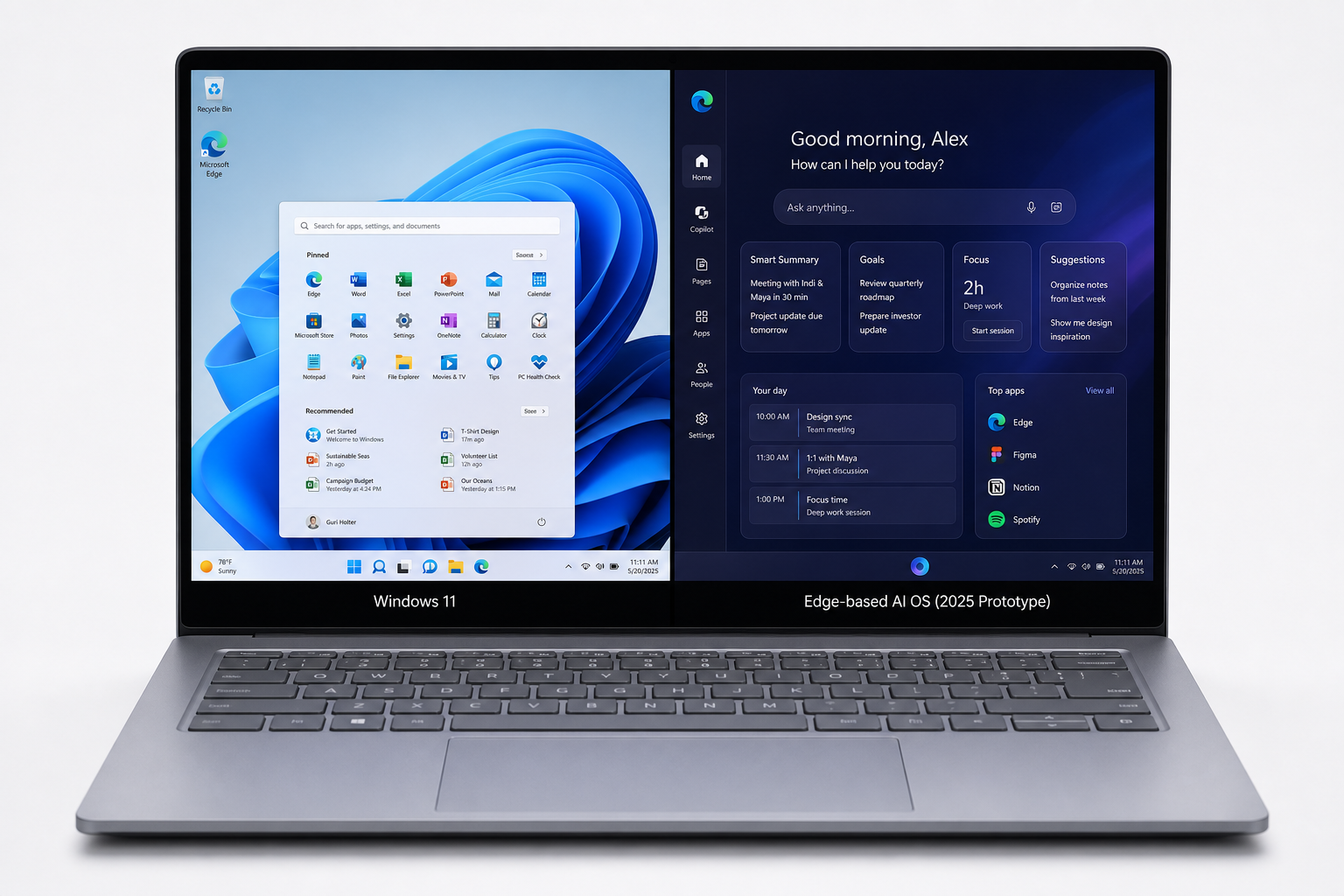
The leaked footage reveals a lightweight Windows OS prototype built on a trimmed-down Windows codebase and powered primarily through Microsoft Edge. Rather than the traditional shell of icons, taskbars, and menus, the interface centres on a Copilot button that serves as the primary entry point for the entire system. Widgets, windows, and even file navigation reportedly surface through Edge-rendered panels — a fundamentally different philosophy from anything Microsoft has shipped publicly.
According to reporting by Neowin, the build dates from 2024 and appears to have been an internal exploration rather than a product on a shipping roadmap. The footage is described as never-before-seen, and Microsoft has not officially commented on its authenticity.
Project Aion: The Edge-Powered AI Operating System
Multiple sources now refer to this prototype as Project Aion. The concept is straightforward: take the Windows kernel, strip out as much of the legacy Win32 shell as possible, and rebuild the user experience on top of Edge and Copilot. The result is essentially an AI operating system that looks and behaves more like a Chromebook competitor than a traditional Windows desktop — but with the full horsepower of native Windows drivers underneath.
- Start button replaced by a persistent Copilot launcher
- Edge-rendered panels handle file management, settings, and app launching
- Minimal legacy UI — classic Win32 chrome is largely absent
- AI-first navigation — users speak or type requests rather than clicking through menus
- Lightweight footprint — designed to run efficiently on AI-accelerated hardware
As Tweaktown reports, the project was Microsoft’s attempt to explore what a browser-based OS centred on Copilot could look like — drawing clear parallels to Google’s ChromeOS strategy, but layered on the Windows ecosystem rather than replacing it.
Why a Lightweight Windows OS Makes Sense Right Now
The timing of this Windows AI leak is no coincidence. Microsoft has spent the past two years aggressively pushing AI into every corner of Windows 11 — from Recall and Cocreator to agentic Copilot experiences announced in late 2025. The broader industry context makes a lightweight Windows OS a logical next step for several reasons.
The NPU Hardware Wave
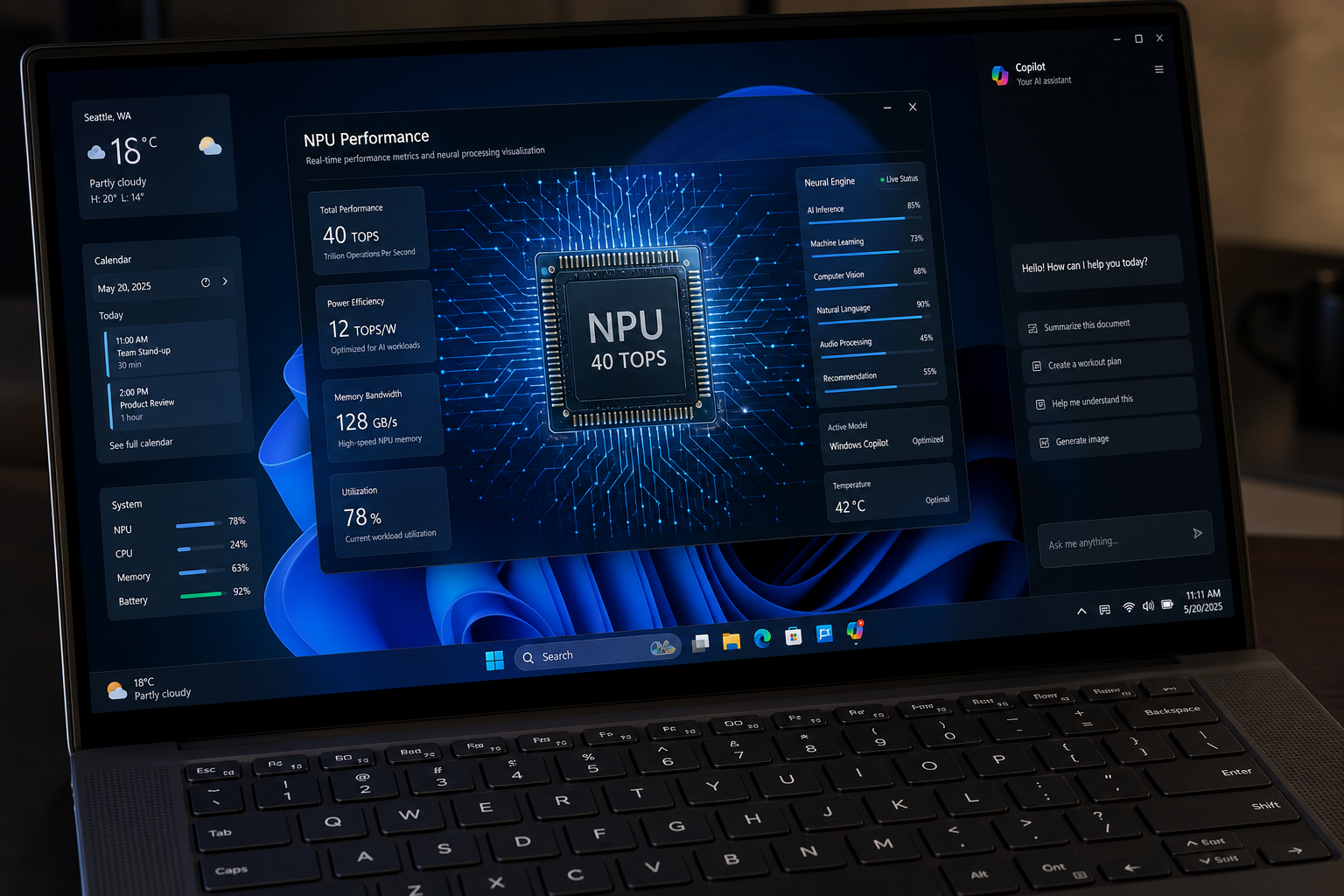
Modern Copilot+ PCs ship with dedicated Neural Processing Units (NPUs) capable of executing more than 40 TOPS (Tera Operations Per Second) of AI inference locally. A slimmed-down OS that offloads traditional shell rendering to Edge and routes interactions through Copilot would make far better use of that silicon than the current, decades-old Win32 shell does. In other words, the hardware is ready — the software has been the bottleneck.
Competing with ChromeOS and macOS
Google’s ChromeOS has long attracted users who want a fast, secure, low-maintenance machine. Apple’s macOS is increasingly integrating local AI models through Apple Intelligence. Microsoft needs a credible answer that does not require users to abandon the Windows ecosystem. An Edge-based Windows 11 AI OS could be that answer — familiar enough for enterprises, fast enough for consumers, and AI-native enough to differentiate on Copilot+ hardware.
The End of Windows 10 Support
With Windows 10 reaching end of support in October 2025, hundreds of millions of PCs face a hardware upgrade cycle. Microsoft has every incentive to make Windows 11 — and any future AI variant — as compelling as possible to accelerate that transition. A lightweight, AI-first build targeting mid-range and budget AI PCs could capture users who currently see no compelling reason to upgrade.
What the Windows AI Leak Reveals About Microsoft’s Strategy
Reading between the lines of this Windows AI leak, a clear strategic direction emerges. Microsoft is not simply adding AI features to Windows — it is experimenting with whether Windows itself can be reconceived around AI interaction. The fact that Project Aion existed internally, even if it never shipped, tells us that serious engineering resources were committed to this vision as recently as 2024.
Copilot as the New Shell
The most provocative element of the leak is the wholesale replacement of the Start menu with a Copilot button. The Start menu has been the defining metaphor of Windows for 30 years. Removing it signals that Microsoft believes natural-language and AI-driven navigation can eventually supersede point-and-click exploration — at least for a specific class of user and device.
Edge as the Platform Layer
Building the UI on top of Edge is also telling. Edge is a Chromium-based browser with deep Windows integration, WebGPU support, and access to Microsoft’s entire web services stack. Using it as the rendering engine for an OS shell means the gap between local apps and web apps effectively disappears — every tool becomes a panel inside an intelligent browser. For AI workloads that blend local inference with cloud APIs, this architecture is pragmatic.
Modular OS Design
Project Aion suggests Microsoft is moving toward a more modular OS philosophy: a stable kernel and driver stack beneath, with swappable shell layers above. The current Windows 11 shell could co-exist alongside an AI-first shell as an optional mode — much like how Windows already supports tablet mode and different accessibility interfaces. This would let Microsoft ship innovation without abandoning the 1.5 billion existing Windows users.
Should You Be Excited or Sceptical?
Internal prototypes leak all the time and most never ship. Microsoft’s research labs regularly explore concepts that never see daylight. So temper your enthusiasm with a dose of realism.
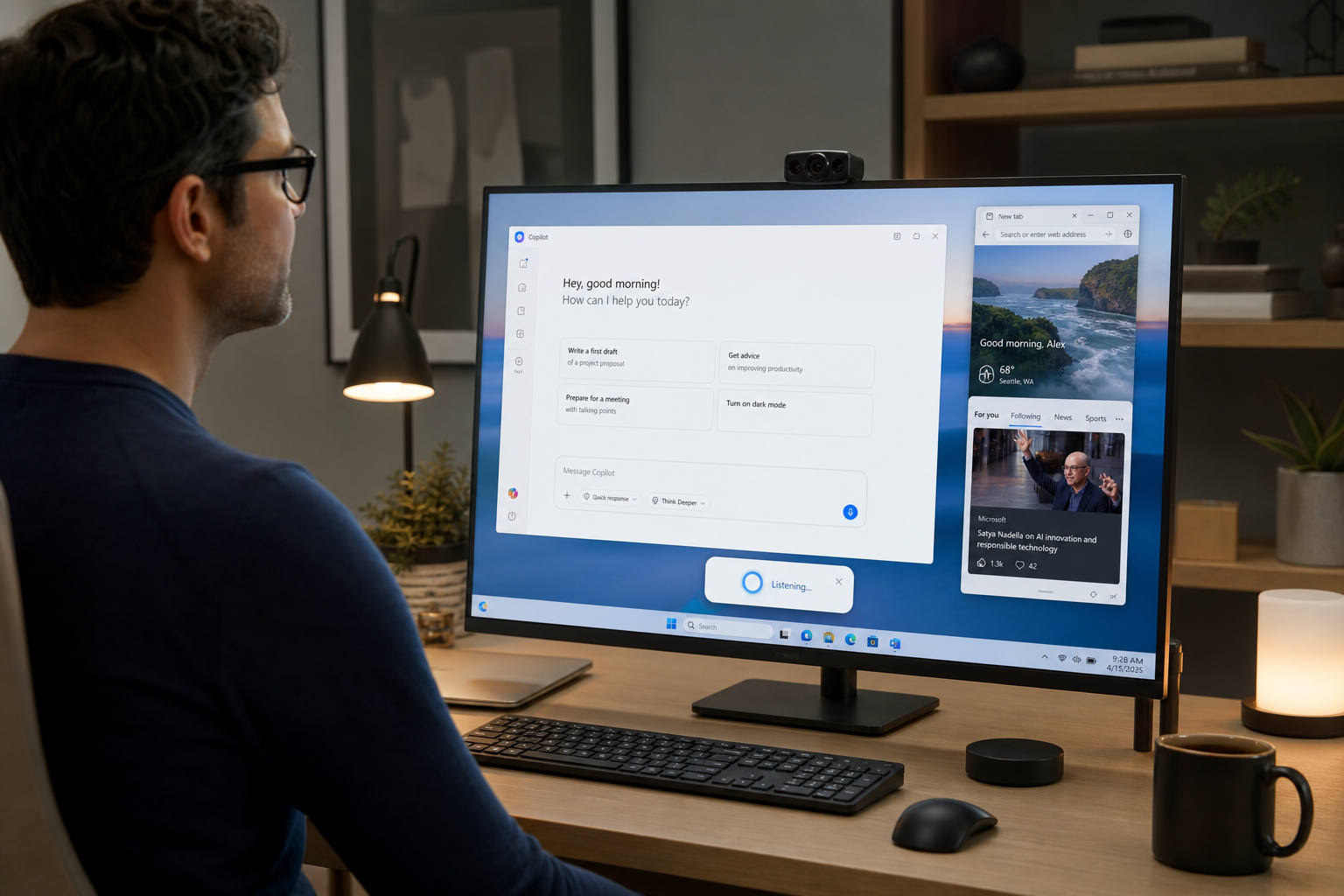
That said, this particular AI operating system concept aligns too precisely with Microsoft’s current public roadmap to dismiss. The company has already announced agentic Copilot experiences for Windows 11 that let the AI take actions on your behalf — browsing, filing, composing — rather than just answering questions. An Edge-centric shell is the logical UI companion to agentic AI. The question is not if Microsoft will ship something in this direction, but when and in what form.
- Optimistic read: A dedicated AI OS variant ships alongside standard Windows 11, targeting Copilot+ hardware — available as a clean install option by 2026 or 2027.
- Conservative read: Elements of Project Aion — the Copilot-first launcher, Edge panels — get gradually absorbed into mainstream Windows 11 updates over the next 12–18 months.
- Sceptical read: The prototype is shelved, and Microsoft focuses on iterative Copilot integration rather than a wholesale shell redesign.
What This Means for Windows 11 Users Today
If you are still on Windows 10 or using an ageing Windows 11 licence, now is a sensible time to get properly set up on the current platform. The AI features Microsoft is rolling out — and any future lightweight Windows OS builds — will target Windows 11 first. You cannot participate in the AI-first future of Windows from a Windows 10 machine.
Beyond the licence itself, it is worth paying attention to which hardware tier you are on. Copilot+ PCs with NPUs capable of 40+ TOPS will gain access to AI features — including anything derived from Project Aion concepts — significantly ahead of standard Windows 11 machines. If you are planning a hardware refresh, prioritise NPU capability alongside RAM and storage.
For a deeper look at how Microsoft is already using AI to optimise Windows 11 performance right now, see our article on AI-based power management in Windows 11 — it covers the efficiency gains that are already live on compatible hardware.
If you need to activate a legitimate Windows 11 licence at the best possible price, explore the Windows 11 Pro + Office 2024 bundle available at TopKeyShop — it includes both a Windows 11 Pro retail key and an Office 2024 Professional Plus key, delivered fast by email.
FAQ
What is the leaked Windows 11 AI OS called internally?
The leaked prototype is widely referred to as Project Aion. It is an internal Microsoft build from 2024 that was never officially announced or shipped. The footage shows a Windows 11 variant where the traditional shell is replaced by an Edge-based interface driven by Copilot AI.
Is the Windows AI leak real or a fake?
The leaked screenshots and video are considered credible by multiple technology publications, including Neowin and Tweaktown, based on the authenticity of the UI elements and the consistency with known Microsoft internal design language. Microsoft has not officially confirmed or denied the build’s authenticity.
Will Microsoft release a lightweight Windows OS based on Edge?
There is no confirmed release date or product announcement. However, the concept aligns with Microsoft’s public direction toward agentic Copilot experiences and AI-first hardware. Elements of the prototype may appear in future Windows 11 updates or as a dedicated Copilot+ PC experience rather than a standalone product.
Does this AI operating system replace regular Windows 11?
Nothing in the leak suggests Microsoft intends to replace standard Windows 11. Project Aion appears to be an exploratory variant targeting AI workloads and lightweight devices. The most likely outcome is that its best ideas get folded into mainstream Windows 11 over time, rather than shipping as a separate OS.
How does an Edge-based Windows OS differ from ChromeOS?
ChromeOS runs Linux underneath a Chrome browser shell and is primarily cloud-dependent. Project Aion’s approach uses the full Windows kernel with native driver support, meaning it retains compatibility with Windows software and hardware — it simply replaces the traditional Win32 shell with an Edge-rendered, AI-first interface. That is a meaningful architectural distinction for enterprise and power users.
Should I wait for the AI OS before upgrading to Windows 11?
No — there is no confirmed timeline for any AI OS release. Windows 10 reached end of support in October 2025, and staying on an unsupported OS is a security risk. Upgrading to Windows 11 now puts you on the platform where all future AI features, including any Project Aion-derived innovations, will land first.
